torsdag den 10. maj 2012

The final days of the X-Men

The destruction and revamping of the team leading up to the Mutant Wars and Chris Claremont’s departure from writing the series.


Following Uncanny X-Men #250 in 1989, the book headed in a new direction featuring “the destruction and revamping of the team,” as phrased by writer Chris Claremont in Marvel Age #85. “As for this new team, we’ve already introduced one new member – Jubilee. Other characters may be developed until they can be considered new people, and in some cases, new characters WILL be introduced.”

The first character to get developed in a new direction was Lorna Dane (formerly Polaris). When her sister Zaladane stole her magnetic powers in Uncanny X-Men #250 in 1989, Lorna Dane mysteriously grew in size and developed extra physical strength and invulnerability instead. In Uncanny X-Men #254 from the same year, Dr. Moira MacTaggert reached the conclusion that Lorna was absorbing energy, but she never got around to perform further tests to determine what energy and from what source. In Marvel Age #85, it said: “No longer Polaris; (Lorna Dane) may soon take on a new super hero name to go along with her new powers.”


Lorna Dane also seemed to have gained the power to catalyse negative emotions. In Uncanny X-Men #257 in 1990, she noticed that she brought forth the worst sides of the people around her, including Legion’s. He had multiple personalities of which the worst was Jack Wayne. He killed Destiny in Uncanny X-Men #255 in 1989 and captured Lorna in #257, intending to take control of everyone on Muir Island through Legion’s telepathic ability. However, in Uncanny X-Men #259 in 1990, the Shadow King possessed Legion and usurped Jack Wayne’s plan.


In Uncanny X-Men #269 from 1990, it was revealed that the Shadow King was now in control of Legion and through him everyone else on Muir Island. Obviously, Lorna Dane’s new powers came along before the Shadow King, but when Chris Claremont left the book, subsequent writer Fabian Nicieza attributed the powers to the Shadow King’s influence, so that when Muir Island was freed from his influence in Uncanny X-Men #280 in 1991, Lorna lost her new powers and shrank to normal size.

In X-Factor #70 from 1991, written by Peter David, Lorna Dane was back to being Polaris, complete with magnetic powers and completely without explanation, ignoring Claremont’s character development.


A brand new Psylocke
Another X-Man who was taken in a new direction was Psylocke. In Uncanny X-Men #255 from 1989, the Hand sent her to Spiral’s Body Shoppe, where Mojo and Spiral transformed her body into that of an Asian woman, so she could better serve as The Hand’s assassin in Hong Kong.


Although Psylocke had simply been through Spiral’s Body Shoppe like Lady Deathstrike in Uncanny X-Men #205 in 1986, that didn’t stop subsequent writer Fabian Nicieza from writing a complicated story in X-Men vol.2 #21-23 in 1993, where Psylocke had instead switched minds with an Asian woman, Kwannon (Revanche). In X-Men vol.2 #31-32 from 1994 he did add that Spiral had been involved with the body switching, though.


In Uncanny X-Men #254 from 1989, the precognitive Destiny had a vision wherein everything was made of the purest crystal. In Uncanny X-Men #255 from the same year, she told Forge that some future elements were obscured in her visions; while others could be perceived so clearly it was as though all eternity had been cast from cut crystal. The crystal in her vision must then have been but a metaphor for a crystal clear future, where the glory that existed in place of all stars and beings - and which finally enveloped her self – was death. A small part of her wanted to deny and fight this destiny, but it was too late to save her self. Throughout the vision she had an hourglass on her forehead with time running out, predicting her own death in Uncanny X-Men #255.


It is possible that the vision was a warning of the danger posed by the Shadow King, because in Uncanny X-Men #279 from 1991 he planned to claim the stars, but Claremont left the series before the vision came true. Subsequent writers took the crystal in the vision literally and used it as inspiration for two connected crossovers between the X-Men line of books in 1995, “Legion Quest” and “The Age Of Apocalypse.”


Cyborg madness

In Uncanny X-Men #260 from 1990, pilot Cylla Markham, a friend of Banshee’s, was badly hurt and in Uncanny X-Men #261 that same year, she accepted an offer from Donald Pierce to become one of his cyborg Reavers. In Uncanny X-Men #269, also from 1990, he made her into his new Skullbuster, replacing the one who had died in Uncanny X-Men #255 in 1989. Claremont didn’t get to introduce the finished result before leaving the series, but in Wolverine vol.2 #55-57 from 1992, writer Larry Hama introduced a cyborg created by Donald Pierce that went by the name Cylla. This cyborg bore no resemblance to the new Skullbuster and was killed off in Wolverine vol.2 #78 in 1994. Then, the original Skullbuster reappeared without explanation in the 1997 Domino mini-series written by Ben Raab.


When Claremont returned to Marvel, Cylla Markham finally debuted as the new Skullbuster in X-Treme X-Men Annual 2001, ignoring what had happened in between his stints as X-Men writer.


In Uncanny X-Men #262 in 1990, Donald Pierce sent his Reavers after his former Hellfire Club colleague Emma Frost, but they never caught up with her. Claremont was building up to a final confrontation between the Reavers and the X-Men, which never happened, because subsequent writer John Byrne had the Upstart Trevor Fitzroy’s Sentinels kill off all the Reavers, except Lady Deathstrike and Cylla Markham, in Uncanny X-Men #281 in 1991. All of them were revived for the X-Treme X-Men 2001 annual, though.


“The Mutant Wars – The First Salvo”

In New Mutants #75 from 1989, writer Louise Simonson dropped the first hint to the coming Mutant Wars crossover in the X-Men family of books. Hellfire Club members Sebastian Shaw and Magneto debated the future of mutantkind, with Shaw mentioning various mutant factions and Magneto predicting a war between those factions.


Four 1990 annuals (Fantastic Four Annual #23, New Mutants Annual #6, X-Factor Annual #5 and X-Men Annual #14) featured a “Days Of Future Present” crossover that set the stage for the “Mutant Wars” crossover that would appear in the regular titles that fall. “X-Factor will play a pivotal role in this fall’s “Mutant Wars,” as the first salvo is fired leading to “Days Of Future Past,”” Marvel Age Preview #1 advertised. “Mutant against mutant, faction against faction, each trying to be the strongest – the survivors. As seen in “Days Of Future Past” (Uncanny X-Men #141-142 in 1981), the future is bleak. The lines have already been drawn, and the mutants in the Marvel Universe have formed their allegiances: The Hellfire Club, Apocalypse’s forces, Sebastian Shaw’s renegade faction of The Hellfire Club, the re-formed X-Men, X-Factor, The Marauders, The New Mutants (led by their mysterious new leader, Cable), Legion (controlled by Farouk (Shadow King), in turn controlling Moira MacTaggert).”


“The first salvo in the Mutant Wars will cross from X-Men to New Mutants to Excalibur to X-Factor for three months this fall. The action will run in a tight continuity from each issue to the next. Only the four mutant titles will be directly involved. The heroes will try to stop the other mutants from splitting into warring factions. But for most, survival is the issue, even if it means sacrificing fellow mutants.”

“Before we reach “The Mutant Wars,” we have to answer some key questions and resolve some major storylines. The new X-Men team will have to be established, and the world will have to learn that they are still alive. Once begun, “The Mutant Wars” will continue to affect the lives of every mutant in the Marvel Universe for years to come. It will be the most important event in the mutant milieu since the death of Phoenix.”

“The issues: X-Men #267-269, New Mutants #95-97, Excalibur #28-30, X-Factor #60-62.”


A big mystery

“The X-Men will come back together to re-form the team – just in time for the first salvo in the Mutant Wars,” Marvel Age Preview #1 announced. “Dazzler, Forge and Banshee are searching for the others, trying to learn who survived the confrontation with (the Reavers in Uncanny X-Men #251, 1989). Their investigations take them beneath the ruins of the X-Mansion, where they face the vengeance of the Morlock called Masque. They are joined by Marvel Girl.”

The Masque story took place in Uncanny X-Men #262-263 in 1990, but without Dazzler. Forge and Banshee learned that she was alive in Uncanny X-Men #260 that same year, but they never searched her out, and she was suffering from amnesia and didn’t remember the X-Men.

“Wolverine, Jubilee and Psylocke also seek their surviving teammates,” Marvel Age Preview #1 stated.

“(Wolverine) sort of cold-bloodedly took Jubilee along with him when he set out to find the other X-Men,” Claremont told Comics Interview #98. “He knew they were alive. He had to find them and bring the team back together, one way or another. In the conception at the time - the storyline I was running - Wolverine was dying and he saw this as his farewell to arms. He was tying up all the loose ends of his life. He was restoring the balance, paying debts. His way of doing that was bringing the X-Men back together whether they wanted it or not.”

“Storm is on the run, trying to escape the clutches of Farouk (Shadow King),” Marvel Age Preview #1 continued. “The evil telepath controls Legion, and through him Muir Island. There, he is creating a dark version of Xavier’s school.”

“Excalibur must liberate Muir Island from Legion in time to prepare for “The Mutant Wars.””

“Colossus is in New York’s Soho, stripped of his memories. In a crossover with X-Factor, he investigates when Ship crashes near his new home.”

Colossus did meet X-Factor in X-Factor #54 in 1990, but in a different story.

“The whereabouts of Havok and Rogue remain to be seen,” Marvel Age Preview #1 stated. “As the heroes draw closer together, events taking place in this summer’s “Days Of Future Present” (in X-Men Annual #14, 1990) make it obvious that the Mutant Wars are about to begin.”

However, when Uncanny X-Men #267 finally appeared, there were no Mutant Wars! But selected Marvel comics cover dated May 1990 (like Sensational She-Hulk #15) featured a Bullpen Bulletins page announcing: “The start of the Mutant Wars in X-Men #271.”

But Uncanny X-Men #271 featured a “The X-Tinction Agenda” crossover instead. What happened to “The Mutant Wars” is a big mystery.


Magneto vs. Shadow King

In Uncanny X-Men #275 from 1991, Magneto recalled an untold confrontation between him and the Shadow King. He felt sick shame at the awful cost of his survival. The circumstances of the confrontation and the shameful cost of Magneto’s survival were never revealed, and when a fan asked about it years later, in 2003, on the online Codially Chris forum, Claremont replied: “I hate to say this but my presumption is that anything dating from the previous millennium, and certainly my first tenure on “X-Men” (as opposed to my second, slightly 21st century tenure) is considered in-house to be ancient history and not worth relating to. Since the likelihood of seeing the Shadow King again is as small as seeing my own incarnation of Magneto, I don’t see the point of revisiting old storylines, and thereby re-opening old wounds. Sorry.”


In Uncanny X-Men #275, Magneto also implied that the Shadow King was part of the Hellfire Club. This revelation corresponded with Excalibur #22 from 1990, where the Shadow King was revealed as the true ruler of the Hellfire Club in the “Days Of Future Past” future of Rachel Summers. “Shadow King didn’t found the Club,” Claremont stated in his Cordially Chris forum, “he simply exploited it for his own purposes.”


In Uncanny X-Men #279 from 1991, Shadow King was in need of a new host body and had several candidates in mind. Who Claremont had intended for him to possess until the final battle with Professor Xavier in Uncanny X-Men #300 in 1993 remains unknown. Claremont left the X-Men with Uncanny X-Men #279, right in the middle of the Muir Island Saga, which featured Shadow King. All of Claremont’s story-elements were dropped between page 12 and 13 of that issue, and new writer, Fabian Nicieza, cut the Shadow King storyline short by having Professor X defeat him in the very next issue.

“My Muir Island story was much different from the one that appeared,” Claremont stated in a 1994 Internet interview.


Why Claremont quit
“What happened was that the editor of the book and I had for a long period of time leading up to that point increasingly disagreed on the direction the book should go in – how the book should be handled,” Claremont told Seriejournalen.dk.

“My feeling is that I was in a position where I was the defining force on X-Men for longer than any of the editorial staff had been in professionel comics, much less working for Marvel,” Claremont explained in Wizard #22. “Yet a change in editor (to Bob Harras) created a situation where all of that credibility, history, and track record meant absolutely nothing. He was in charge. His decision was policy. My responsibility as an employee was to follow that policy or get the hell out of the way.”

“The problem was that (artist) Jim (Lee) was just as strong-willed as I was,” Claremont revealed in Comics Creators On X-Men. “Jim wanted to do stuff that reminded him of the things that made him get into comics in the first place. He wanted to bring back Magneto and do the Sentinels and all that sort of stuff. My problem was I’d already done those things… at least twice. I wanted to try and find some new stuff to do. New stuff for the new millennium, you know! We couldn’t find any sort of common ground that would allow us to compromise. Rob Liefeld had just forced Louise Simonson off New Mutants and that left a lot of frustration and negative resonance. Bob Harras was editing X-Men in those days and he was a lot more simpatico to Jim than he was to me. (…) Bob and Jim wanted to do what they wanted to do and the feeling was I could not or would not go along, and they were going to do it anyway.”

“The editor (Bob Harras) at that point made the decision that I should no longer plot the book,” Claremont told Seriejournalen.dk. “And when he made that decision I made my decision, which was that I wasn’t going to stay on it if I wasn’t plotting it – and left. The transition occurred on page 12 of Uncanny X-Men #279 (in 1991). That’s the last page I wrote.”

“The circumstances of my departure were such that there was no opportunity to tie up those loose ends,” Claremont said in Comics Focus #1, regarding all the unresolved subplots. “There was no practical way of doing it.”

“Wish I’d done differently?” Claremont asked himself 18 years later on Xmennation.com. “Gotten along better with Jim (Lee) and Bob (Harras) back in the day. Who knows what might have happened to sales back then had we stuck together?”


The editor’s point-of-view

“When Jim (Lee) came aboard, he had a lot of ideas about what he wanted to do with the book and where he wanted to take the characters, and I liked those ideas,” editor Bob Harras admitted in Comics Creators On X-Men. “They were more in keeping with what I thought the book should be. With X-Men, there are some things you can’t get away from for too long: The school dynamics, Xavier, the fact that they’re essentially students learning how to use their powers and trying to teach other mutants to use their powers – that sort of thing.”

“But the book was becoming more like Avengers. The X-Men now had aliens and magically-powered characters on the team. I felt like we had to go back to what X-Men was all about, and to me X-Men was Xavier and Scott and Jean and all the other classic characters. But Chris didn’t want to do that kind of stuff any more. He felt that he had done it already. My point was, “Sure, but THAT’s the X-Men!” It was getting so we were speaking the same language, but we couldn’t understand each other.”

“The other thing was, as the books were coming out during all this tension, they were getting better and better. There was more excitement in them. So I thought, “Okay, if we can get through this, Chris will see that we’re having a great ride here.” Not that it was pleasant, but the tension was being transformed into really dynamic comics that people were reacting to. I thought, “If we can just ride this out a little longer, everything’s going to settle down.” But that didn’t happen.”

“I had read Chris’ X-books for years, so his leaving was huge. I really wanted to work it out. I wanted Chris and Jim to be a team. When Chris opted out, there was this definite feeling of, “Holy shit!” But another part was, “Okay, we can still do this.” Because I DID believe in the characters, the concept, and that we could keep going.”


That year, in 1991, Fabian Nicieza wrote the “Kings Of Pain” crossover in New Mutants Annual #7, New Warriors Annual #1, Uncanny X-Men Annual #15 and X-Factor Annual #6 featuring the new villain Harness (Erika Benson) and her son Piecemeal (Gilbert). Harness was working for the A.I.M. organization and it was revealed that she also had a seven years old daughter who was in the care of A.I.M. However, Harness never appeared again, and her daughter never appeared anywhere at all.

Sources:
?: Chris Claremont, Internet interview, 1994
Comics Focus #1, June 1996
Cordially Chris, comixfan.com/xfan/, 16 June 2003
Tom DeFalco: Comic Creaters On X-Men, April 2006
Jordan Lurie: Creating Claremont, xmennation.com, 3 June 2009
Marvel Age #85, February 1990
Marvel Age Preview #1, 1990
Patrick Daniel O’Neill: Chris Claremont, Comics Interview #98, 1991
Patrick Daniel O’Neill: Claremont Returns With The Write Stuff, Wizard #22, June 1993
Tue Sørensen and Ulrik Kristiansen: Chris Claremont Interview, seriejournalen.dk, 1995

torsdag den 26. april 2012

Strip-mining Wolverine

How he got the adamantium bones and the false memory-implants.


In 1988, Wolverine received his own ongoing series while still appearing in Uncanny X-Men. “I’m not surprised (Wolverine) became so popular because he is a really cool guy,” former X-Men artist John Byrne told Back Issue #4. “I wish he hadn’t gotten his own series. I think he’s kind of like a lot of Marvel characters – I always think of the Vision, who’s another really cool character, but who’s mostly cool because he’s in a group of people who aren’t like him. And Wolverine is the same – he’s in a group of people who aren’t like him, and therefore he’s really cool. But if you take him out of that environment, then there’s no checks, no balances, nothing for him to bounce off. Then you just have a homicidal maniac running around killing people.”

“If I’d had my way, there would have been no ongoing series at all, but instead an annual mini-series with a defined beginning, middle and end,” X-Men writer Chris Claremont agreed to Berserkher.com. “The problem with an ongoing title is that you must provide perpetual grist for the mill. With a solo character, it’s only a matter of time before the temptation becomes irresistible to strip-mine those aspects of his history and character which make him so interesting and mysterious in the first place.”

“A retailer recently told me, “If the audience wants 25 Wolverine series, give them 25 Wolverine series. Stuff the product down their throat like a goose, until they pop,”” Claremont recalled in Wizard: X-Men Turn Thirty. “This doesn’t work because to me – I wanted to keep the work vital, I wanted to keep the creators interested and I wanted to keep the audience interested, but also I wanted to keep as much of the structural integrity of the canon as possible. This isn’t possible when you have Wolverine appearing regularly in X-Men, his own series and Marvel Comics Presents, plus guest-starring in Secret Defenders, whatever. I mean, for a guy who is fundamentally a loner, he gets around.”


Landau, Luckman & Lake
Claremont introduced the villains Roughouse and Bloodscream in Wolverine vol.2 #4 in 1989. By their speech patterns, it was obvious that they were from Asgard, yet subsequent writer Archie Goodwin established Roughouse as a human in Wolverine vol.2 #17-23 from 1989-1990, and in Wolverine vol.2 #78 from 1994 Larry Hama established Bloodscream as a vampire from the Medieval Age. In Wolverine vol.2 #123 written by Tom DeFalco in 1998, Wolverine did suspect that Roughouse was Asgardian and Bloodscream part vampire, part elf, though. Finally, years later, in the 2008 Iron Man: Director Of S.H.I.E.L.D. Annual #1 written by Christos N. Gage, they were back to being Asgardians.


Claremont then introduced the company Landau, Luckman & Lake in Wolverine vol.2 #5 in 1989. The local expediter, Chang, had a picture of Wolverine and himself from the 19th century hanging on the wall in the Madripoor office.


Wolverine and Jubilee visited Landau, Luckman & Lake’s Hong Kong office in Uncanny X-Men #257 in 1990 where the local expediter, Rose Wu, also had a picture of Wolverine and herself on the wall, but this one was apparently taken in the future.


In Wolverine vol.2 #97 in 1996, subsequent writer Larry Hama interpreted the pictures as Landau, Luckman & Lake being an interdimensional company with doorways to other dimensions in each office. In Wolverine vol.2 #97, he also suggested that Rose Wu was a shapeshifer. Writer Howard Mackie filled in the story behind the pictures in the 1996 Logan: Path Of The Warlord one-shot.


In Wolverine vol.2 #5, Wolverine had ordered a costume from Chang for “a colleague,” who turned out to be Psylocke, who started wearing the costume in Uncanny X-Men #232 in 1988. It was revealed that the costume wasn’t of earthly origins when it was used to defeat Bloodscream. The origin of the costume remains unrevealed.


“As it stands now there are plans to bring Jean Grey in for an issue to do a “Casablanca”-type story,” editor Bob Harras revealed in Marvel Age #78. “We also have plans for Archangel to battle Wolverine. It’s, basically, anyone we can get to Madripoor.”

Those stories never appeared, however, as Chris Claremont left the series in 1989 with issue #10.


Weapon X

When the X-Men met X-Factor during the 1989 Inferno crossover, the former X-Man Angel had been transformed into Archangel by the villain Apocalypse. In Uncanny X-Men #242, Wolverine subconsciously recognized Apocalypse’s scent on Archangel, which brought forth memories of pain in Wolverine.

In 1991 Barry Windsor-Smith wrote and drew a Weapon X serial in Marvel Comics Presents #72-84. “Wolverine’s adamantium heritage had never been explored, so I aimed at that device,” Windsor-Smith told Wizard Tribute To Wolverine. “After I created several Weapon X stories, I had a conversation with Chris Claremont in which he told me that he had always intended for Apocalypse to be the villain behind the adamantium experiment. For no reason other than courtesy to Chris, I devised the situation where the professor in the story was taking his orders from a higher-up. Despite this hindrance to my plot, I felt it best to give Chris the chance to eventually fulfill his wish to have Apocalypse be the real villain behind the adamantium experiment. Chris never got the chance to do his ultimate origin for Wolverine but know that whenever the professor is being belittled by the guy at the other end of the phone in Weapon X, it’s Apocalypse.”


In the 1990 Wolverine: The Jungle Adventure one-shot written by Walter Simonson, Wolverine found an old adamantium skull in one of Apocalypse’s old lairs, but subsequently other writers have ignored the hints to Apocalypse’s involvement in the Weapon X project. In Wolverine vol. 3 #50-55 from 2007, writer Jeph Loeb introduced the character Romolus who was the alpha male of the race Lupus Sapiens which had evolved alongside Homo Sapiens. Characters like Wolverine, Sabretooth, Wild Child, Wolfsbane, Feral and Thornn were Lupus Sapiens. Romolus had orchestrated events in Wolverine's life from behind the scenes, including the Weapon X experiment and Romolus was the one the professor had been talking to in Barry Windsor-Smith's Weapon X story. 


“To me, Wolverine should have no official origin,” Claremont told Berserkher.com. “Pieces of his life should forever remain a closed book. As for the rest, every writer has their take on the character, and their stories reflect that. What I did with Wolverine was what saw print. What I would have done remains in storage for another day, should I get the chance to write him long-term again.”


Wolverine and Shadowcat

Chris Claremont told Back Issue #4 about his thoughts concerning Wolverine’s mentoring role with Kitty Pryde (Shadowcat): “The Kitty role is part of a larger, panoramic tapestry that had X-Men: True Friends #1-3 (1999) come out when it was supposed to, in the late ‘80s or the very early ‘90s. It would have put all this into a lot more of a context. The whole relationship between Kitty and Logan (Wolverine) is more complicated and far-reaching than had been suspected up until that point.”

“Kitty was someone that Logan took under his wing because he knows things about her that she doesn’t know. Even then I was playing with the idea that there is a linkage between them that goes back well before she was born. If you accept as part of the canon the timeline structured out by True Friends, Logan’s thought about Kitty since the 1930s. Then you have to ask yourself, “Is the fact that the X-Men went to Deerfield in X-Men #129 (1980) an accident? Whose idea was it to go seek her out? Was it Charley, using Cerebro, or did Wolverine whisper something in his ear? If she’s part of the team because he set it up, what’s going on? Where is this going to lead?””

“Then if you factor in the whole Days of Future Past myth, all sorts of interesting implications come popping up. Again, that’s me doing my grand design with a specific character.”

When X-Men: True Friends, which is set before Weapon X, finally came out in the late ‘90s, it had Wolverine using his claws, but in 1993 Wolverine writer Larry Hama established in Wolverine vol.2 #75 that Wolverine didn’t know that he had natural claws prior to the Weapon X project.

“The characters moved off in different directions, they got acquired by different writers and different books, and the things that I had intended got shuffled away in the mist,” Claremont told Back Issue #4.


False memories

In Wolverine vol.2 #50 from 1992, written by Larry Hama, Wolverine learned that many of his memories were implants given to him during the Weapon X project. “Well, that’s one of the fortunate things about Wolverine,” Byrne opinionated in Back Issue #4. “It’s like the Doctor Doom robots that I set up so any stupid Doctor Doom story immediately becomes about a robot. Any stupid Wolverine flashback immediately becomes an implanted memory.”

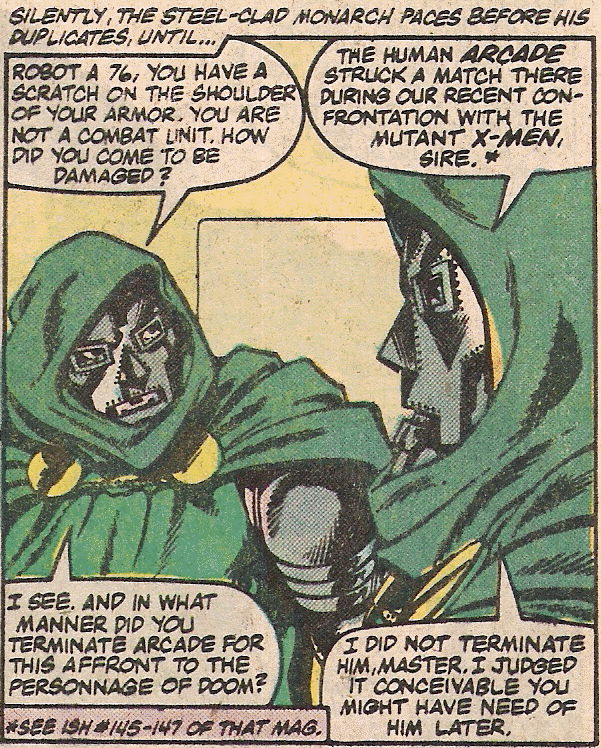
Byrne had not liked Claremont’s handling of Doctor Doom in Uncanny X-Men #145-147 in 1981, so in Fantastic Four #258 in 1983 he invalidated the story by establishing that the X-Men had only dealt with a Doombot, rather than the real Doctor Doom.

“(I like) Larry Hama’s take on Wolverine,” Claremont revealed in Back Issue #4. “It wasn’t what I would have done, but I liked reading it a lot. Larry Hama and Marc Silvestri (in Wolverine vol.2 #31-43, 45, 46, 48-53 and 55-57 from 1990-1992).”

“And, of course, the beauty is what they have done is to basically say everything you know about his past is a lie,” Claremont added in Wizard: X-Men Turn Thirty. “Therefore, most of the stories you have been reading for the past 20 years are a lie. But, of course, the stories we are telling you now could be a lie.”

Chris Claremont wrote a classic story for Wolverine vol. 2 #10 in 1989 in which Sabretooth killed Wolverine's girlfriend Silver Fox back in the wild west which originated the tradition that Sabretooth would hunt Wolverine every year on Wolverine's birthday. This story was written off as a menory implant by Larry Hama in Wolverine vol. 2 #48-50 from 1991/1992 where Silver Fox turned out to still be alive and the leader of a branch of the criminal Hydra organisation. She was killed off in Wolverine vol. 2 #63 and then writer Jeph Loeb re-established the story from Wolverine vol. 2 #10 as having happened after all. This was in Wolverine vol. 3 #50-55 in 2007 where Sabretooth did indeed kill Silver Fox as a "birthday present" to Wolverine back in the wild west. Wolverine had a vague recollection of Silver Fox turning up alive, but it was never explained who or what the Hydra Silver Fox were.


The memory implants were burned out of Wolverine’s brain in Wolverine vol.2 #68 in 1993, so only the flashbacks to his past printed before that issue could be called into question.

“I decided that (Wolverine’s origin) was a story that should never be told,” Claremont continued in Wizard: X-Men Turn Thirty. “I feel that the drive to explain every split second of every character’s existence is absurd. Where’s the mystery? Where’s the fun if you nail it all down?”

“To me, it was like he should be a man of mystery whose past you infer. There will be all sorts of little clues that you could perhaps list in order to build a comprehensive overview of what his past is. If someone wanted to go write a scholarly paper on who is Wolverine and where did he come from, you could take all these benchmarks and deduce from this that he is A, B, C and D.”


Stories yet to be told

In Wolverine vol.2 #62 from 1992, Larry Hama unveiled a list of “the original Weapon X Project team” that included the codename Wildcat. However, that character never appeared anywhere.

Then, in Wolverine #80 from 1994, Larry Hama introduced molecular biologist Dr. Jaime Munoz who believed that it was possible to develop a bonding process for Adamantium based on a tissue sample from Wolverine. He asked for former Weapon X subjects to step forward to facilitate a breakthrough in Osteopedics. He also warned Wolverine that he had identified an unstable chain of Nucleoproteins in the tissue sample. It was a defect in Wolverine’s DNA that might cause him problems in the future. However, Wolverine never approached Dr. Munoz and the subject of the DNA defect was never touched upon again.


“The problem I have with Logan is I don’t see very much that’s new,” Claremont stated in Back Issue #4. “I see a lot of people running over the track over and over again. I don’t see much of an evolution of the character. I don’t see much that tells me something new in terms of insights or perceptions or what have you that we didn’t have years ago. That would be my hope if I ever got to write him on a consistent basis again, to try and play with the shadings and gradations of the character to see if I could come up with some insights, some perceptions, some revelations which are small but integral, which change how you look at him.”

“In terms of the X-Men, nothing in the mix of characters really suggested themselves as being gay,” Claremont told Seriejournalen.dk. “I had a story with Wolverine where that could be explored. I never got around to writing it.”

Asked on his online Cordially Chris forum if he had any story ideas for Logan’s mother, Claremont answered, “As a matter of fact, yes.”

Sources:
Kim A.: Chris Claremont On Wolverine, Berserkher.com, 2001
William Christensen and Mark Seifert: From Gofer To Comic Great, Wizard: X-Men Turn Thirty, July 1993
Cordially Chris, comixfan.com/xfan/, 28 October 2008
Eric Fein: Bob Harras Interview, Marvel Age #78, September 1989
Peter Sanderson: Pro 2 Pro – Claremont And Byrne: Wolverine At 30, Back Issue #4, June 2004
Tue Sørensen and Ulrik Kristiansen: Chris Claremont Interview, seriejournalen.dk, 1995
Wizard Tribute To Wolverine, 1996

torsdag den 12. april 2012

Cosmic comedy with Excalibur

But the Phoenix mini-series didn’t make it to print, Colossus didn’t make the team, and Nightcrawler’s Captains Courageous team wasn’t assembled.


On the letters page in Uncanny X-Men #208 in 1986 it was announced: “Rachel (Summers)’ going to need all the friendship and support and affection she can get, not simply in the X-Men but also in the upcoming Phoenix Limited Series we have planned for later this year, which Chris Claremont will be writing and Rick Leonardi pencilling. We think it’ll be something as different and special as the lady herself.”

According to Marvel Age #43, the first issue of Phoenix would feature "the dread villainess Spiral (remember her from Longshot and, more recently, the Freedom Force?) and lots of psycological ramifications and complications. It examines how Rachel is coping with being in a past that resembles - but isn't quite - the one that proceeded her world. She will meet Power Pack in the first issue and see little Franklin Richards. In her time, Rachel is in love with a grown Franklin! Here he is a child, and she is much older than him, and this situation will cause her to do some serious soul searching. There will also be lots of cameos and guest appearances, lots of flash-forwards, and lots of of fantastic visuals by Leonardi and Green."


However, the Phoenix mini-series never appeared, although it remained in the works until Chris Claremont left Marvel in 1991. “In (Uncanny) X-Men #209 (1986), she was spirited away by Spiral to Mojo’s world and something awful happened, which is going to be explained in a Special Format mini-series,” Excalibur artist Alan Davis told Amazing Heroes #193. “I don’t know if Chris has finished writing it yet.”

“(The Mutant Massacre crossover) was supposed to lead into a mini-series which would tell the story of what happened between Rachel’s disappearance from the X-Men in issue #209 and her reappearance in the Excalibur special edition (in 1988),” Claremont told Comics Focus #1. “This was supposed to tie into Longshot’s presence in the X-Men and his departure from that book to star in his own ongoing series. Except, for various reasons, the mini-series never got finished and the Longshot series never got launched, so suddenly you’re left with dangles that weren’t intentional but are there nonetheless.”

“Plots come and go for all sorts of reasons. Threads dangle for all sorts of reasons. The writer assumes that there will always be time to tie them up in neat little knots – things that are meant to come to fruition fifty issues down the line will happen. I always assumed I’d be around to do it: Unfortunately, I wasn’t.”

In the Excalibur Special Edition, Phoenix returned from Mojo’s world without the capacity to tell her true memories from the false memories she had gotten in his world of entertainment. It wasn’t a big mystery what had happened to her, though, as it was mentioned - and repeated in Excalibur #1 and X-Men Annual #12 in 1988 - that Mojo had made her a star in his world, and that she had escaped from being kept as his slave.


Hello, Excalibur

“It’s no secret that I’ve been wanting to work with Alan Davis for some considerable time,” Claremont told Amazing Heroes #134. “Basically, in the past what I wanted him for is to draw the X-Men.”

“I like working with Chris (Claremont) very much,” Alan Davis stated in Amazing Heroes #193. “But the difficulty is, if you go on to a book like X-Men, you’re just another new artist on the X-Men, and unless you somehow make a tremendous splash you’re selling yourself into a slavery of working on something where you can’t really do too much because the formula is tested and so successful.”

“The first I knew of Excalibur was when Chris phoned and instead of asking, did I want to draw the X-Men, said Marvel is doing another X-book and it’s going to be set in England and Captain Britain is in it,” Davis recalled in Modern Masters Volume One. “Now Chris was one of the creators of Captain Britain, so he obviously had an interest in him. So I don’t know whether Captain Britain was included in the group to encourage me.”

“Usually, when you move on to an existing book, you’re following a regime, and by starting on Excalibur with issue #1, I was able to put a lot of myself into it,” Davis explained in Comics Scene #30. “I liked the characters, and it was nice to be in on something since its inception.”

 “I began figuring what could I do with the X-Men who weren’t going to be in the (1988) Fall Of The Mutants (crossover), like Kitty (Pryde) and Nightcrawler,” Claremont told Amazing Heroes #134, “because I knew if I didn’t do anything with them, other people would leap forward like rabid wolves to heist them. Alan (Davis) and I had been talking over the idea of doing something together – a graphic novel, a series, or some such. And then basically the concept of Excalibur evolved, and we decided on a team, which would be Shadowcat (Kitty Pryde), Nightcrawler, Captain Britain, his girlfriend Meggan, Phoenix, and someone new whom we’d invent (Widget).”

”Originally, Colossus was also intended to be a member of Excalibur. However, Colossus ended up rejoining the X-Men for the basic reason that the X-Men didn’t have a big, muscular strongman, and as the Excalibur concept grew along, and Captain Britain came into it, we already had a strongman in Excalibur – we didn’t need two. And the X-Men needed one, so we tossed Colossus back.”

When Chris Claremont brought Captain Britain into Excalibur, he did not touch upon an unresolved 1977 mystery from Marvel Team-Up #65 and 66 where the European Maggia put a hit on Brian Braddock and several others who were suspected of being Captain Britain. While Spider-Man helped out Brian Braddock on a visit to New York, a mysterious woman - who was listening in on the hit being contracted to Arcade at an airport in London - took out the men who hired Arcade and saved the intended victims in England. Her identity was never revealed. It has been speculated that she was Lt. Sabrina Morrel whom Claremont intoduced in Spider-Woman #39 in 1981, but this is doubtful as Lt. Morrel was based in San Francisco where the mystery woman in Marvel Team-Up #65 and 66 was based in England.


Goodbye, Excalibur

“When we originally started, (editor) Ann Nocenti christened Excalibur “a cosmic comedy,”” Alan Davis told Comics Scene #30. “That was something that really surprised me, because what I had originally agreed to do was basically the X-Men in Europe, and suddenly it was a cosmic comedy. I was told it was because my artwork was so comedic, and while it wasn’t my decision, there was a definite intention to put more humor into Excalibur. There’s always a punchline on the cover, or a humorous incident.”

Alan Davis told Radio Rackham in 2024: "When I was working with Chris on various X-Men or Excalibur, they would have the annual all-titles-in-one storyline and it was just a farce, just everyone wanting to be the star of this one piece. It would get the writers being very protective of their ideas because the problem that a writer faces is, he's selling an idea and once someone takes that idea from them, they've got nothing else to sell. So the writers would always be late handing you a script because they didn't want to give anyone else time to steal their ideas. That was why I initially gave up on Excalibur, just because the scripts were always late and I was having two weeks to draw an entire issue. And that meant that the inker also didn't have enough time and the colorist didn't have enough time and it was because the writer didn't want anyone to have their ideas."

Alan Davis decided to leave Excalibur with issue #17 in 1989, “Mainly because we were working right up against the deadline all the time and there was no way of getting out of that situation. That was affecting the quality and the look of the book,” Davis explained in Amazing Heroes #193. “I had a great time working with Chris (Claremont) and working on Excalibur was heaven-sent, making it a really difficult decision to give it up. (…) I agreed to do the two fill-ins on Excalibur (#23-24 in 1990).”

Ten issues later, Chris Claremont also gave up Excalibur. “Part of the reason I dropped Excalibur was that X-Men (vol.2) was on the horizon and we wanted to start the new book in somewhat less than the extreme deadline situation we always seemed to find ourselves in on Uncanny X-Men,” Claremont explained in Comics Interview #98. “Also, at the time, I felt Excalibur wasn’t any fun anymore. It had gotten to the point where there was no postive synergistic mix between myself and the people I was working with as pencillers. Rather than perpetuating a book that wasn’t zinging, it was easier to just remove myself from the situation and focus my energies on X-Men.”

With Claremont’s departure, the story announced for 1991 in Marvel Age Preview #1 ended up not happening: “Excalibur goes bi-weekly for the summer, and Nightcrawler forms the Captains Courageous, gathering the Captain Britains from across the multiverse.”

Girls’ School from Hell

Claremont’s final Excalibur story was “Girls’ School from Hell” in Excalibur #32-34 from 1990-1991 – a story that was originally scheduled for Excalibur #7 in 1989 according to Marvel Age #72, and which was to preceed the Excalibur: Mojo Mayhem special edition: “Even in England, Kitty’s education can’t be neglected, so the Excalibur team sends her off to a private girls’ school. But Kitty’s in for a shock when the school turns out not to be what she expected! Written by Chris Claremont and illustrated by Alan Davis.”

““The Girls’ School from Hell” would have worked really well with Alan (Davis),” Claremont told Comics Interview #98. “I thought, when we set out to do it, that it would work as well with Ron Wagner, based on the work I saw on Nth Man – it just didn’t work. What I was looking for, what (editor) Terry Kavanagh and I were hoping for, didn’t gel. It’s no fault of Ron’s, it’s no fault of ours; it’s just one of those things.”

The two Excalibur Special Editions promised in Excalibur #22 in 1990 became the 1999 X-Men: True Friends mini-series instead.

Of Claremont’s abandoned Excalibur plots, one remained unresolved. In Excalibur #21 in 1990, Jamie Braddock turned the head of London’s criminal underworld, Vixen, into a fox and she was last seen as such in Excalibur #27 in 1990. Presumably, she is still a fox.


In Excalibur #32 in 1990, Sat-yr-9’s henchman Nigel Frobisher had become the new Vixen, but whatever plans he had remained unfulfilled, because the subsequent writer, Alan Davis, killed him off in Excalibur #56 in 1992.


Kitty Pryde: The new Saturnyne?

“I phoned Chris Claremont and asked him if he would have any problems with my going back to the book, because almost immediately after he left, they offered it to me,” Alan Davis told Comics Scene #30. “I didn’t want it to look like there was foul play. That’s not what actually happened, and I didn’t want it to appear that way.”

“When I took over on Excalibur, there was a definite brief that there were too many loose ends hanging and (editor) Terry (Kavanagh) wanted them tied up,” Davis admitted in Modern Masters Volume One. “Fortunately, I was able to manage to tie the loose ends up so that many people thought that was the way Chris (Claremont) had planned it all along.”

There was one plotline that Davis initially left for Claremont himself to resolve. “From issue #5 (1989) of Excalibur we’d been building up a subplot where we had Sat-yr-9, Doc Croc, the Vixen, and Jamie Braddock coming together for a climactic battle, which still hasn’t happened, although Chris Claremont is planning on doing that in a special series at some point in the future,” Davis revealed in Marvel Age #100. When Claremont left Marvel before doing the series, Davis used Sat-yr-9, Vixen and Jamie Braddock anyway. In Excalibur #55-56 in 1992, the heroes learned that Sat-yr-9 had killed Captain Britain’s old girldfriend, Courtney Ross, and had posed as her since Excalibur #5. However, Davis didn’t reveal why Sat-yr-9 had taken a special interest in Kitty Pryde, whom she had befriended in Excalibur #21 in 1990 and had spoiled with an amazing birthday celebration in Excalibur #24 the same year.

“From what I gather in terms of the current X-Men, it’s not part of the mix,” Claremont told Seriejournalen.dk. “The key to (the X-Men) was always to deal with (the characters) in terms of how they interacted with the real world – that they were a part of the real world, that they lived in the real world, that they had a future in the real world. That at some point Storm might well marry Forge and go on living happily ever after – or not. That Nightcrawler and Amanda (Sefton) had a future. That Kitty would or would not become the new Saturnyne. All these elements were there.”


Loose ends from Lobdell and Raab's runs
After the end of Davis’ run with Excalibur #67 in 1993, Uncanny X-Men writer Scott Lobdell plotted the book until #82 in 1994. He began a subplot with Kitty Pryde’s father, Carmen Pryde, in #76, where he left a message on Kitty’s answering machine that he would always love her. Then Kitty couldn’t reach her dad on the telephone in #78, and in #79 Forge got a file of corporate info on Carmen Pryde who apparently had gotten into some trouble Forge couldn’t help him with and had disappeared. Then the next Excalibur writer, Warren Ellis, didn’t pick up on the subplot until #96 where Kitty talked about the cryptic phone message and said she hadn’t heard from her dad since, and she mentioned her dad again at the end of the 1996 Pryde And Wisdom miniseries, but Warren Ellis didn’t get around to having her look for him before he left Excalibur with #103. New writer Ben Raab didn’t pick up on the plot at all before Excalibur got cancelled with #125 in 1998. Finally, in 2002, Chris Claremont wrote a Kitty Pryde story for X-Men Unlimited #36 where she finally found out what had happened to her dad. He had died in the Sentinels’ destruction of Genosha in New X-Men #115. Whatever Scott Lobdell had in mind for Carmen Pryde’s story after Excalibur #79 and what brought him to Genosha remains unknown.

Excalibur writer Ben Raab also left a loose end behind when the series got cancelled. The Doctor Strange villain Nightmare was testing the members of Excalibur’s with nightmare scenarios they had to break out of in Excalibur #119. At the end of the issue, Nightmare said he would share what he had learned about the Excalibur members with “a mutual friend” and then “woe be to” them, but the identity of the “mutual friend” was never revealed.


Sources:
Les Chester: Alan Davis, Amazing Heroes #193, August 1991
Comics Focus #1, June 1996
Tom DeFalco: Comics Creators On X-Men, April 2006
Marvel Age #72, March 1989
Marvel Age Preview #1, 1990
Joe Nazzaro: Punchlines, Comics Scene vol.2 #30, December 1992
Eric Nolen-Weathington: Modern Masters Volume One: Alan Davis, April 2003
Patrick Daniel O’Neill: Chris Claremont, Comics Interview #98, 1991
Radio Rackham: Interview: Alan Davis, SoundCloud, 28 May 2024
Peter Sanderson: Alan Davis On Excalibur, Marvel Age #100, May 1991
Peter Sanderson: High Caliber, Amazing Heroes #134, February 1988
Tue Sørensen and Ulrik Kristiansen: Chris Claremont Interview, seriejournalen.dk, 1995